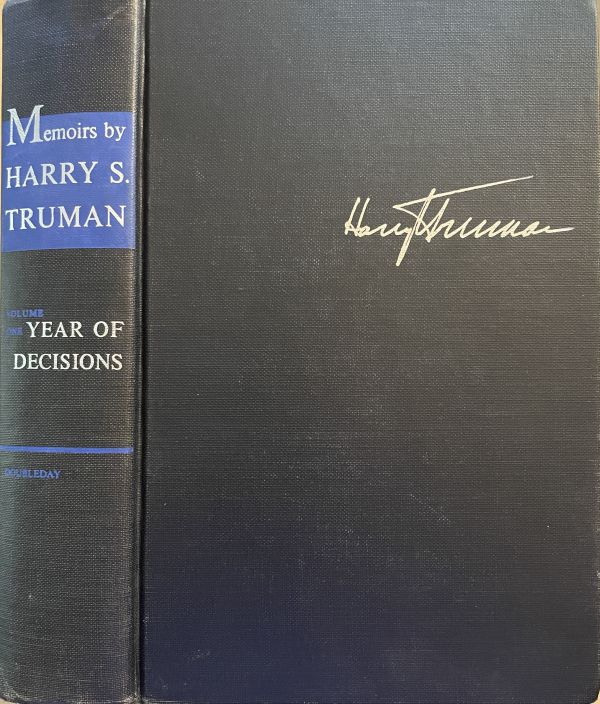

Year of Decisions is a story of America at its greatest. But it provides a sad contrast to the America in decline 80 years later.
High Point: The first-person insights into world-changing decisions such as the use of nuclear weapons, support of the United Nations, and much more.
Low Point: The minutiae associated with some of the routine daily activity of the President.
Author: Harry S. Truman
Publication Date: 1955
Genre: Biography
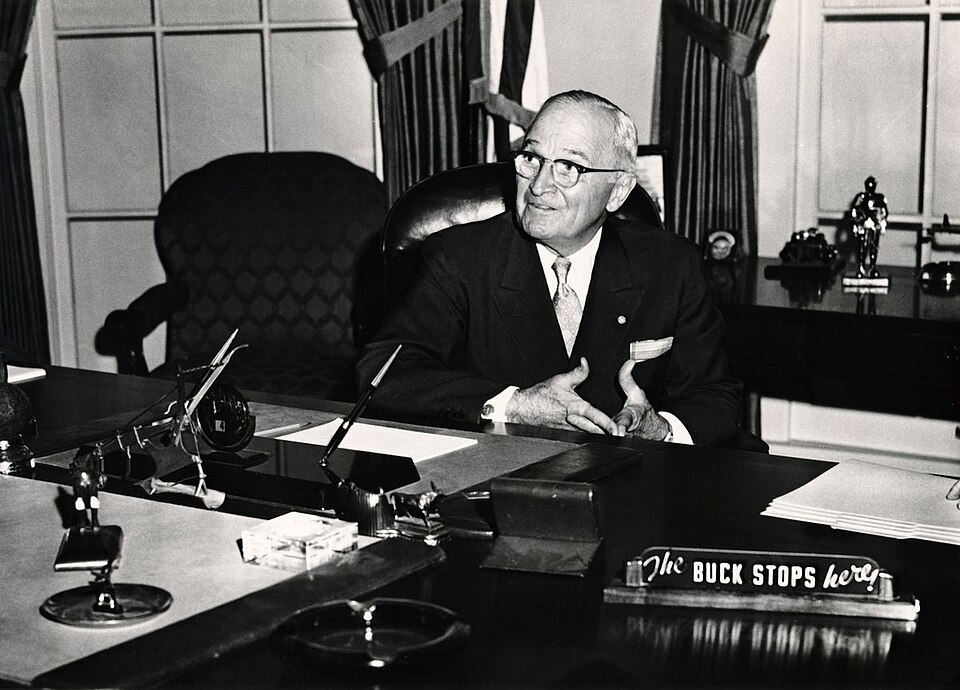
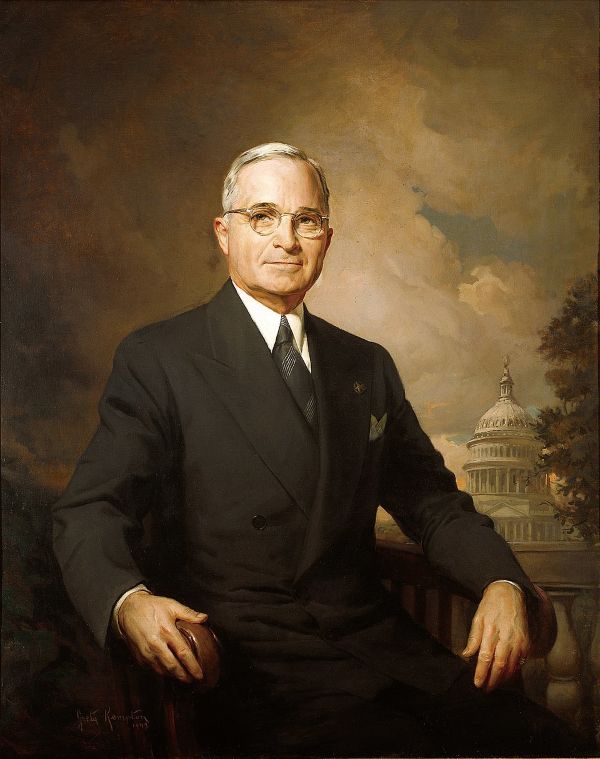
Scholars generally rank Harry Truman among the ten most effective American presidents. Year of Decisions, the first volume of his presidential memoirs, highlights his worth during his first year as America’s leader.
Truman’s Decisions
This book immerses you into Truman’s concerns and efforts as he leads the United States and its allies through the end of World War II and into the first crucial months of peacetime. This is a deep dive into his daily activity beginning with his summons to take the oath of office following Franklin Roosevelt’s death in April 1945.
During his first year, Truman was faced with enormous decisions that would change the world forever. His accounts provide incredible insight into his reasoning and motivation as he pondered these decisions.
Truman takes us through the first critical days of his new presidency. To begin with, he attempts to catch up on actions needed to conduct the war on two fronts. He talks about his input into the initial conference that helped produce the United Nations, and his hopes for the new force for keeping peace. He provides intricate detail of the month spent at the Potsdam conference near Berlin with Winston Churchill and Joseph Stalin.
His decision to employ nuclear weapons against Japan was a relatively quick one. But Truman makes it clear it was to save the estimated 500,000 American casualties expected if the Japanese homeland were invaded.
America as a Superpower
And then Truman illustrates at length America’s responsibilities as the new world superpower. He was particularly concerned about supporting European nations as they attempted to rebuild their infrastructure and economies. He implemented stringent programs that required sacrifice from Americans in order to help Europeans feed themselves—knowing those programs would help produce the stability necessary to maintain a peaceful Europe.
Truman’s Leadership
Truman’s personality shines throughout the book. At the oddest times, he injects letters he wrote to his mother and sister Mary back in his hometown of Independence, Missouri. And his well-known irascibility breaks through the narrative from time to time—such as when he concluded one letter to his Secretary of State by declaring, “I’m tired of babying the Soviets.”
And he’s not immune from blaming misfortune on his political opponents. For example, he blames his failed haberdashery business on the economic policies of Republican president Herbert Hoover. (But he later enlists Hoover’s help to assist with the recovery programs after the War).
Truman maintains threads of a number of themes in his memoirs, but a couple are highlighted repeatedly.
One, leaders should study history, not only of their own countries, but those of other nations as well. There is too much to learn to ignore history.
And second, government is for the welfare of all the people, and not just for those in power.
Year of Decisions is a story of America at its greatest. But it provides a sad contrast to the America in decline 80 years later.
Quotes
Senator Truman
| [Advice from Senator Ham Lewis of Illinois to freshman Senator Truman] “Don’t start out,” he told me, “with an inferiority complex. For the first six months you’ll wonder how you got here, and after that you’ll wonder how the rest of us got here.” |
| My ten years in the Senate has now begun—years which were to be filled with hard work but which were also to be the happiest ten years of my life. |
The War
| Our motorcade then drove to the center of Berlin and turned to drive down Wilhelmstrasse to the remains of the Reich Chancellory, where Hitler had so often harangued his Nazi followers. I never saw such destruction. “That’s what happens,” I said, “when a man overreaches himself.” |
| The big towns like Frankfurt and Darmstadt were destroyed, but the small ones are intact. It is awful to see what the bombs did to the towns, railroads, and bridges. To think that millions of Russians, Poles, English and Americans were slaughtered all for the folly of one crazy egotist by the name of Hitler. I hope it won’t happen again. |
| The final decision of where, and when to use the atomic bomb was up to me. Let there be no mistake about it. I regarded the bomb as a military weapon and never had any doubt that it should be used. |
| We had won the war. It was my hope now that the people of Germany and Japan could be rehabilitated under the occupation. The United States…wanted no territory, no reparations. Peace and happiness for all countries were the goals toward which we would work, and for which we had fought. No nation in the history of the world had taken such a position in complete victory. No nation with the military power of the United States of America had been so generous to its enemies and so helpful to its friends. Maybe the teachings of the Sermon on the Mount could be put into effect. |
Leadership
| The simple truth as I see it, and as I saw it then, was that the country should be run for the benefit of all the people and not for just the special crew who has the inside track. |
| History taught me that the leader of any country, in order to assume his responsibilities as a leader, must know the history not only of his country but all the other great countries, and that he must make the effort to apply this knowledge to the decisions that have to be made for the welfare of all the people. |
| There is no substitute for a fact. When the facts are known, reasonable men do not disagree with respect to them. |
Sources For This Book
This book was purchased at BoneAnza Barn – Glen Rose, Texas
Free eBook (Project Gutenberg): Not available
Free Audiobook (LibriVox): Not available
Available for Purchase: AbeBooks, Biblio, Thriftbooks
