

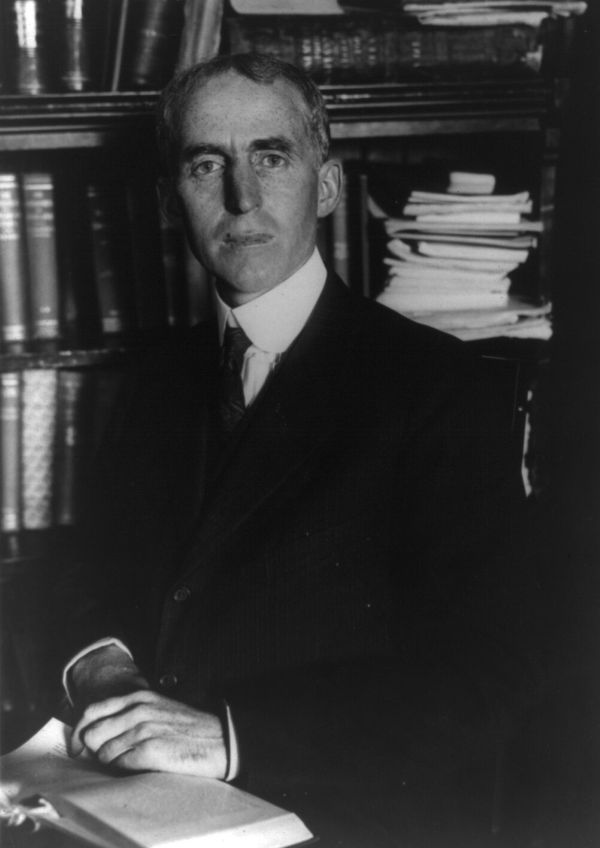
Whither Mankind often reads like a college textbook, but the messages are striking in their relevance today. With minor revisions, many of these observations and concerns could have been written last week.
High Point: The striking similarities between issues in the Machine Age and those we face today.
Low Point: One author cites the Ku Klux Klan as a service organization.
Authors: Various (edited by Charles A. Beard)
Publication Date: 1928
Genre: Social Science
Whither Mankind, published in 1928, describes the impact of the Machine Age on different segments of society. Nearly a century later, the book feels surprisingly fresh as 21st century humans emerge from the Information Age into what comes next: the Fourth Industrial Revolution or whatever we call this next period of incredible technological change.
The book, edited by historian Charles A. Beard, is a compilation of essays generated by a Who’s Who of the world’s sociologists, political scientists, philosophers and educators from the 1920s. Writers were assigned specific topics such as Business, Health, the Family, Religion, Education and so on.
The writings include fascinating perspectives on a world dealing with massive change. Some are amazingly prophetic. Others reveal how little some things have changed. Still others are somewhat sad because they express hopes that we now know never came to fruition. Among the highlights:
- In “Law and Government”, American political scientist Howard Lee McBain speculates about the impact of radio and television on political campaigns. He also expresses concern about the adverse effect on the accuracy of news reporting caused by the proliferation of the powered printing press and the telegraph.
- German author Emil Ludwig, in “War and Peace”, calls the previous decade’s global conflict “The World War” not knowing that humans would soon be tagging it as World War One to differentiate it from the second war. He expresses hope in a younger generation, saying that humans have outgrown war.
- In “Education”, American educator Everett Dean Martin laments the poor pay and general lack of support endured by the nation’s teachers.
- Various writers refer to the Ku Klux Klan—one including it as a service organization in the same sentence with the Kiwanis and Rotary Club. Another lists the Ku Klux Klan alongside religious fundamentalists.
Whither Mankind often reads like a college textbook, but the messages are striking in their relevance today. With minor revisions, many of these observations and concerns could have been written last week.
Quotes
From “Play” by Stuart Chase
| College football while amateur in name is professional in spirit, and constitutes what is known as a major industry. A good team is not only the chief claim to fame of a given college; it is also frequently its financial backbone. |
| What the age of machinery has given us in time, it would fain take away again by degrading the opportunities which that time affords; by standardizing our recreations on a quantity production basis, by making us watchers rather than doers, by exploiting our leisure for profit, by forcing the page of competition in play until it turns into work, and above all by brutalizing in recreation millions of human beings who are already brutalized by the psychological imperatives of their daily labor. |
Patrick Colquhoun quote from “Business” by Julius Klein
| Poverty is…a most necessary and indispensable ingredient of society, without which nations and communities could not exist in a state of civilization. It is the lot of man. It is the source of wealth, since without poverty there could be no labour; there would be no riches, no refinement or comfort, and no benefit to those who may be possessed of wealth. |
From “War and Peace” by Emil Ludwig
| Every era of great wars enkindles anew the will to peace. It seems as if, in this respect, men remain all their lives, like children who abstain from sugar only when and as long as they suffer from stomach ache as a result of too much nibbling. |
| The wars of our time had their genesis in the minds of a few; they could be brought into being, however, only through the aid of propaganda, which averred that those who live “over there” are different from ourselves and are therefore evil, having what we do not possess and longing to possess what we have. …The chauvinists have always flattered their own folk, and defamed foreign peoples. |
From “Education” by Everett Dean Martin
| The new ways of living necessitated important revaluations, new forms of social control, restatement of many of the aims of culture. There has been tragic blundering. New and hitherto inarticulate elements of the population—frequently people with but few civilized interests and almost no cultural tradition, or social responsibility—have risen to power. In the industrial struggle many priceless values, won out of a long past, have been temporarily lost. Others survive in antiquated form, which often renders them irrelevant and sentimental in their modern application. In the general confusion, it is the habit of those with unsolved problems to offer education—usually the education of someone else—the masses—as the long sought solution. |
| The teaching profession does not offer to its members a career, comparable in attractiveness with the opportunities of business or of some of the other professions. It goes without saying that many high-grade men and women are in this profession out of devotion to scholarship and service to humanity. But such devotion calls for a degree of self-sacrifice which is not commonly expected of persons and other occupations. Financial reward is small, advancement is slow and difficult, preferment depends largely upon the goodwill of superiors, who are often administrators rather than scholars. |
| But education is always diverted from its true aim and made to serve ends, which are irrelevant—the state, the church, popular notions of morality, efficiency, ambition, social security. |
| After every intellectual awakening in history, the masses have risen up in an effort to block it out or repudiate its real meaning, and have made use of popular religious ideas as weapons in their struggle against a movement which at once demanded too much of men, made them feel inferior and robbed them of their traditional consolations. |
| I have watched many local elections of members of boards of education and have noted the fact that commonly petty personal interests and crowd partisanship result in the choice of incompetent persons, who influence upon public education everywhere is to make it not only susceptible to crowd prejudice, but an actual fabricator of mob ideas. |
Sources For This Book
This book was purchased at Zenith Bookstore in Duluth, Minnesota
Free eBook (Project Gutenberg): Not available
Free Audiobook (LibriVox): Not available
Available to Purchase: AbeBooks, Biblio, Thriftbooks
