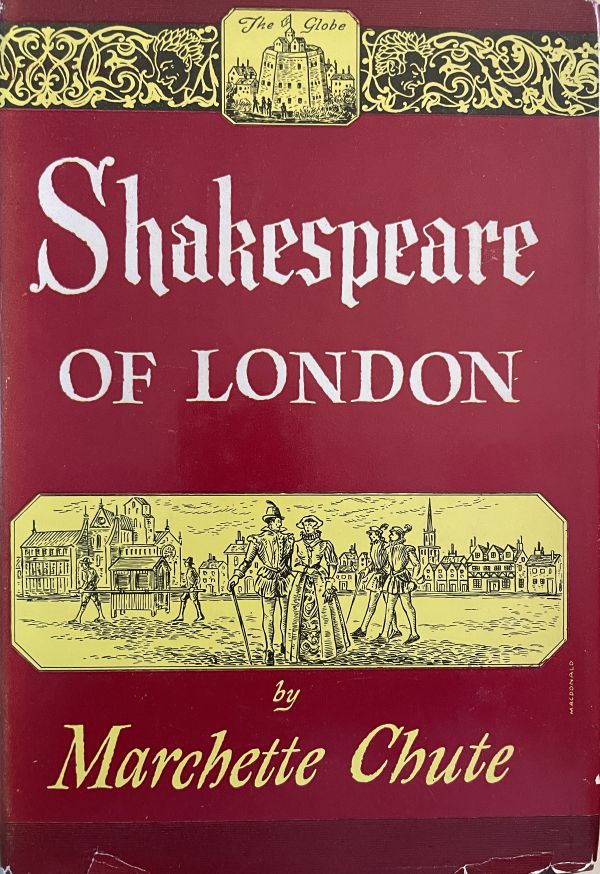

In Shakespeare of London, biographer Marchette Chute provides a grounded look at William Shakespeare—focusing on how his contemporaries saw him rather than relying on the legend that has evolved over the last 400 years.
High Point: Chute delves into the origins and creation of some of Shakespeare’s greatest works.
Low Point: Chute provides little depth in discussions of Shakespeare’s great sonnets.
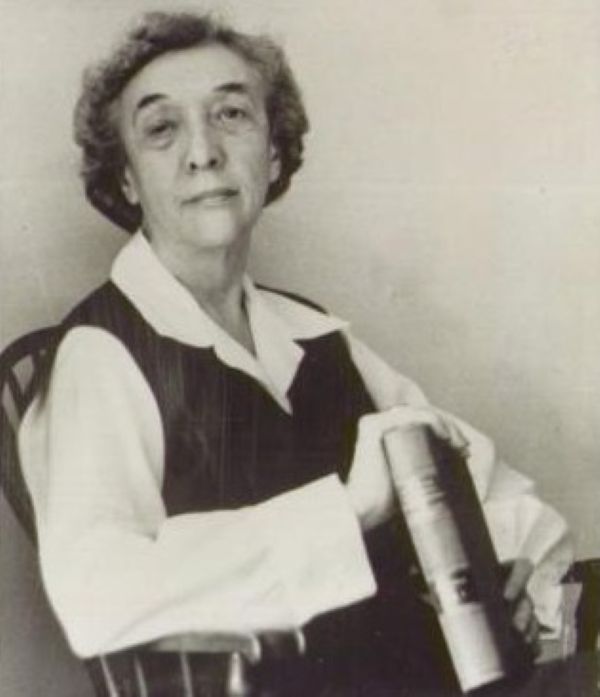
Author: Marchette Chute
Publication Date: 1949
Genre: Biography
Listen to the audio version of this review
space
In Shakespeare of London, biographer Marchette Chute provides a grounded look at William Shakespeare—focusing on how his contemporaries saw him rather than relying on the legend that has evolved over the last 400 years.
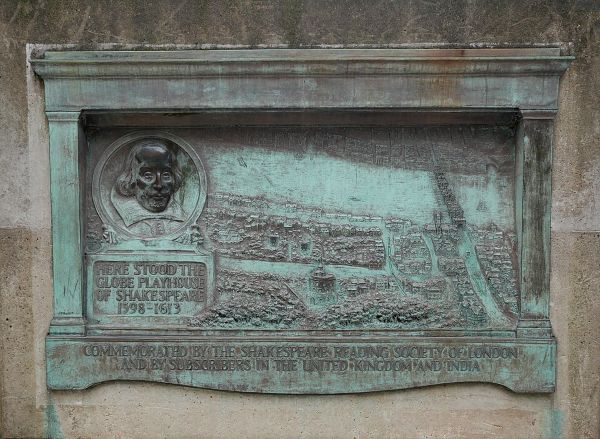
This approach allows Chute to portray Shakespeare in a rich historical and social context. While he is the central figure, we also become well acquainted with many of Shakespeare’s peers such as Ben Jonson, Christopher Marlowe, and other writers, actors, and key players. We learn how the theatres were established and developed, including the famous Globe Theatre.
Best of all, Chute delves into the origins and creation of some of Shakespeare’s greatest plays such as Romeo and Juliet, Hamlet, and MacBeth. She tells about the playwright’s inspiration for his characters, such as Shylock in The Merchant of Venice.
Chute’s narrative is engaging, rarely sinking into the dry tone of a lecture or textbook. Instead, it’s almost conversational in style, especially when she occasionally shares her opinion on some topic or another.
This biography excels in providing a realistic portrait of Shakespeare and his environment without the heavy analysis and conjecture that has often surrounded him and his works. If there is a notable weakness, it may be that Chute just scratches the surface on the great sonnets. Although she includes an appendix to address those works, there’s little depth to her discussion.
Regardless, for those who are not that familiar with Shakespeare the person, Shakespeare of London may be the place to begin. Start with Chute’s fact-based, context-rich account, and you’ll be better-equipped to navigate the centuries of guesswork and speculation surrounding the person so often hailed as the foremost writer of the English language.
Quotes
| The people of England, and especially of London, still took a rather provincial view of foreigners. Visitors from the Continent spoke with some bitterness of the self-satisfaction of the English, whose highest praise for any foreigner was that it was a pity he was not an Englishman. |
| …Shakespeare never concerned himself about being in the forefront of any literary movement. He was no innovator, and to the end of his career he was willing to take decrepit, old-fashioned stories as the basis for his plays while his colleagues dealt in glossy new inventions of their own. |
| It was not until the Puritan Commonwealth that the convention was established that men were supposed to have an entirely different life to women and many of a boy’s natural qualities were choked out of him as “unmanly.” The situation was different in Shakespeare’s day, and the boys of his company understood perfectly what moved a young girl to laughter or to tears. |
| Even in his folk portraits he was unable to prevent himself from seeing real human beings, and where his audiences expected only a comic villain they got Shylock. “I am a Jew. Hath not a Jew eyes? Hath not a Jew hands, organs, dimension, senses, affections, passions? …If you prick us, do we not bleed?” |
| The word that comes to mind in connection with Shakespeare is not “art” but freedom. He went his own way and made his own laws. By the time King James came to the throne, Shakespeare was the master of every art of language and a torrent of such force makes its own channels. |
Sources For This Book
This book was purchased at The Published Page Bookshop in Cleburne, Texas.
Free eBook (Project Gutenberg): Not available
Free Audiobook (LibriVox): Not available
Available to Purchase: AbeBooks
