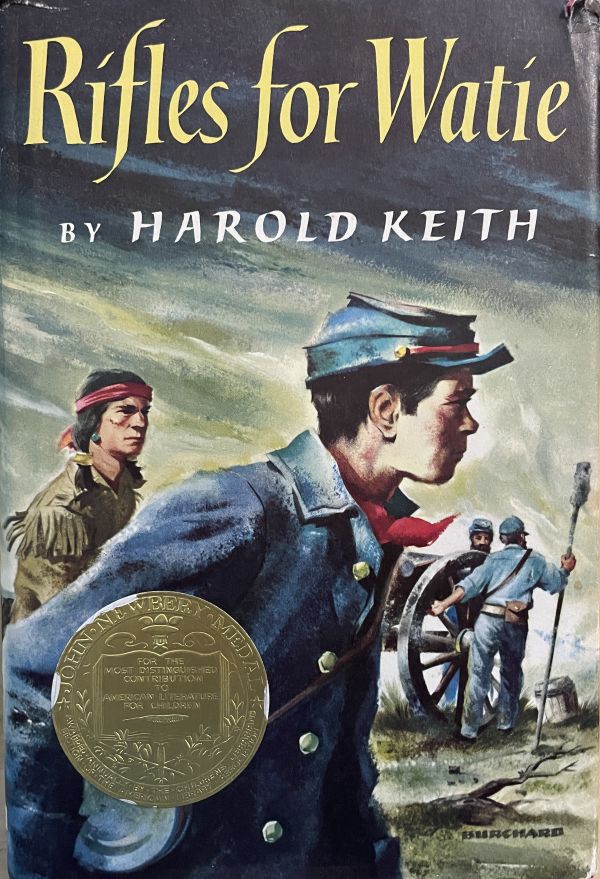


Written for young adults, Harold Keith’s Rifles for Watie is a snapshot reflecting American racial attitudes of the mid-20th century.
High Point: It’s a gripping story as the young protagonist faces the fear, the violence and sudden deaths of friends.
Low Point: Slavery is never presented as an injustice. Black slaves are depicted as happy and devoted to their masters.
Author: Harold Keith
Publication Date: 1957
Genre: Fiction – Young Adults
Listen to the audio version of this review
Among the benefits of getting old is having the firsthand experience of seeing massive change over the decades. We can understand the impact of climate change beyond simply looking at the data. We remember those cold Friday night football games when we wore sweaters and coats instead of shorts and flipflops. We’ve ridden the technology developments that drove the evolution from paper and pencils to PCs and smartphones. And we’ve witnessed the shifts in social attitudes—in many cases, the shift of our own attitudes.
A Gripping Story
Written for young adults, Harold Keith’s Rifles for Watie is a prime example of how we have changed. The story follows a sixteen-year-old boy who leaves home to join the Kansas volunteers of the Union army during the Civil War. Through the end of the war, we watch as he matures into a young man.
It’s a gripping story as he faces the fear, the violence and the sudden deaths of friends. He also comes to know soldiers and families from the Confederate side of the war. He develops an empathy for his adversaries—noting the similarities with his own side—even pursuing a romantic interest with a young Confederate woman.
Shifting Racial Attitudes
But this book—published in 1957—reflects the attitude of many white Americans in the mid-20th century. The boy concludes that—rather than fighting for the retention of slavery—the Confederate families are understandably fighting for their own country as he is fighting for his. Slavery is never presented as an injustice. The Black slaves are depicted as happy and devoted to their masters.
The N-word is used frequently. Rather than used as an expletive, the term is applied casually—often identifying a Confederate family’s property. Its use in that manner seems more offensive than when thrown out as a deliberate slur.
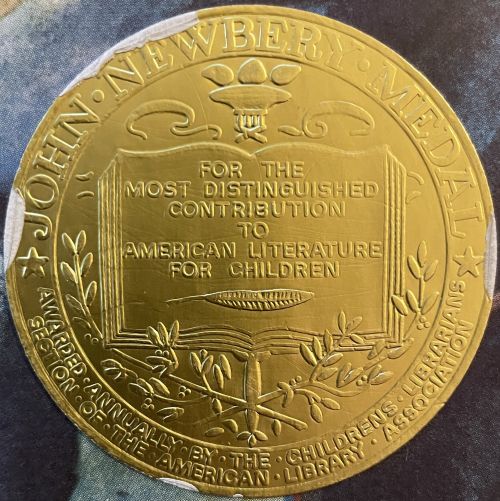
In 1958, Rifles for Watie won the American Library Association’s John Newbery Award for the most distinguished contribution to children’s literature. That’s a distinction the Association would likely withhold from this book today. As recently as 2022, the Newbery Award was granted to a book subsequently banned by a Florida school district. That’s usually a sign of a book that’s more socially inclusive, and certainly a sign that the Association’s mores have changed.
A One-Time Favorite
Rifles for Watie was a favorite book in junior high. As such, it’s a reminder of my seventh-grade Texas history teacher who insisted the bad guys won the civil war and that slavery would have died out on its own anyway. He didn’t mention that while we sat in a brand-new air-conditioned school, the descendants of those slaves were segregated across town learning about the civil war in an old sweltering school building.
Thankfully, those folks soon joined us in our better schools; Rifles for Watie would likely not be written and celebrated today; and most of us old guys have learned to put aside such stupid prejudices and attitudes.
Sources For This Book
This book was purchased at the Antique Mall of Mansfield in Mansfield, Texas
Free eBook (Project Gutenberg): Not available
Free Audiobook (LibriVox): Not available
Available to Purchase: AbeBooks, Biblio, Thriftbooks
