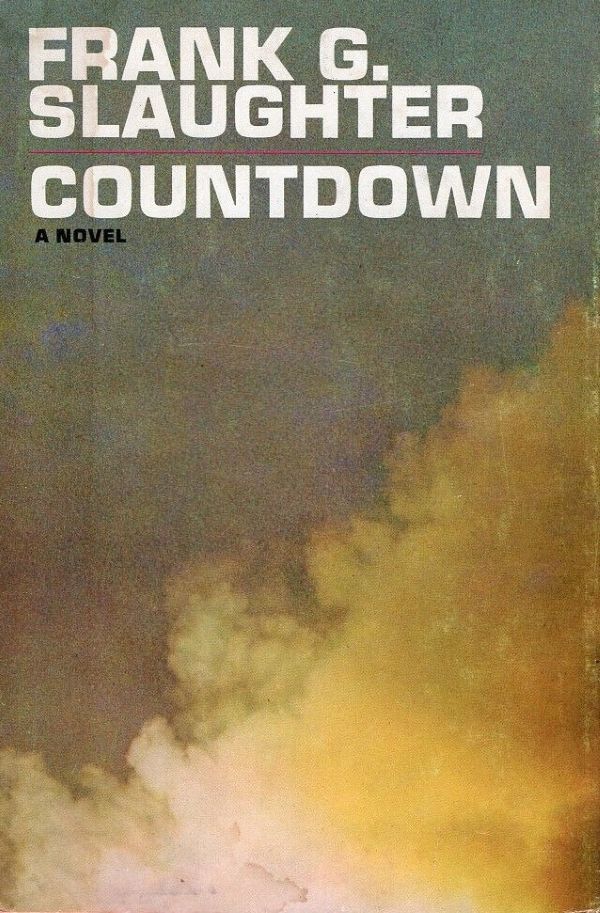


Countdown is so 1960s and 70s that one can almost see the bellbottoms, hear the Rolling Stones, and smell the glue and the grass.
High Point: The overall plot is creative with the potential of being a captivating story.
Low Point: The novel lacks credibility regarding the technology associated with the story. It’s much too simplified–even for fiction.
Author: Frank G. Slaughter
Publication Date: 1970
Genre: Fiction
Listen to the audio version of this review
s
Countdown by Frank G. Slaughter is so 1960s and 70s that one can practically see the bellbottoms, hear the Rolling Stones, and smell the glue and the grass. That heavy sense of the period, unfortunately, may be the most interesting aspect of the novel.
The story follows a disgraced ex-astronaut who returns to Cape Canaveral to clear his name. At the same time, he’s enlisted to investigate the potentially dodgy development of a new super rocket for use after the Apollo missions.
It’s written along the lines of Michael Crichton’s bestselling novel Airframe, but without the credible technological foundation exhibited by Crichton. In Countdown, the technology, space agency procedures, and the manner in which events unfold are grossly oversimplified. It ruins what starts out as a solid storyline.
One rather appealing feature is the way in which it reflects some of the predominant attitudes of its age. The fear of the escalating Soviet military buildup is illustrated by advocating the militarization of space. The boredom with the later Apollo missions is demonstrated by questioning the need and expense of manned spaceflight and exploration.
That slight appeal, however, does not save the novel. Countdown should be counted down—and out.
Sources For This Book
Free eBook (Project Gutenberg): Not available
Free Audiobook (LibriVox): Not available
Available to Purchase: AbeBooks, Biblio, Thriftbooks
