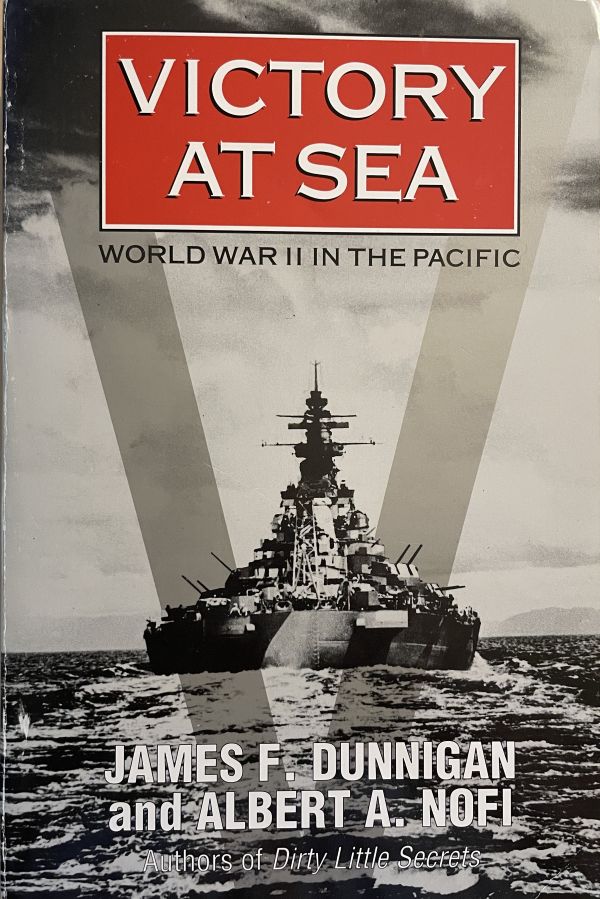



A comprehensive account of the Pacific war, Victory at Sea represents a massive amount of research. It vividly portrays the staggering cost of war in terms of wasted resources, money and human lives.
High Point: The conclusion is a daily diary of the war from beginning to end.
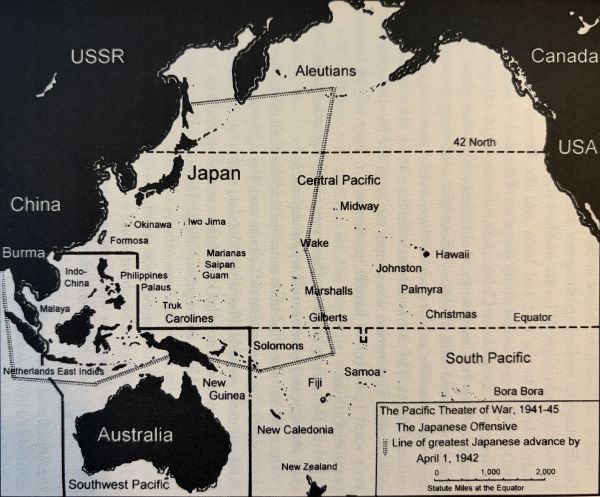
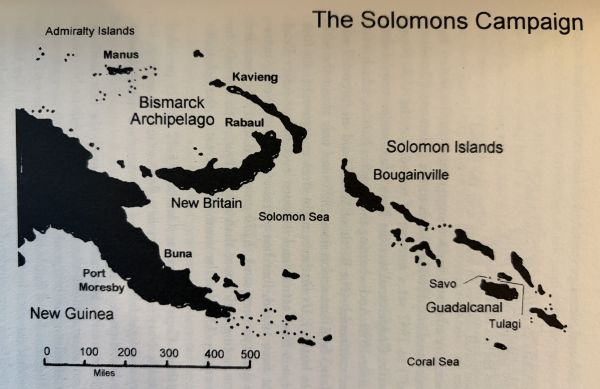
Low Point: There are only three maps and no photographs, sketches or drawings.
Authors: James F. Dunnigan & Albert A. Nofi
Publication Date: 1995
Genre: History
Listen to the audio version of this review
space
Six Hundred Pages of War—and Only Three Maps
In the prologue of Victory at Sea, authors James F. Dunnigan and Albert A. Nofi suggest that using this World War II history as a reference book “is probably the least satisfactory way of using it.” In fact, it’s probably the most sensible way to use it.
A comprehensive account of the Pacific war, this book represents a massive amount of research. You’ll find details of the ships, aircraft, campaigns, personalities, and many other aspects of the Allied and Japanese nations.
Informal and Conversational
Rather than the stilted style of a textbook, the authors’ narrative is informal and conversational. They don’t hesitate to use a casual idiom from time or time, or to throw in an occasional sarcastic comment—helping to keep their book of facts and descriptions of events from sinking under the weight of its own data.
That informality even extends to a few of their chapter titles. For example, there is one called “The Boring Stuff”—which actually was quite interesting.
One Big Miss…
However, there is at least one big miss that serves to relegate this work as a reference book rather than as a cover-to-cover read. This 612-page book contains only three maps and not a single photograph, sketch or drawing. The chapters about ships and aircraft are full of text, but you’ll need to stop reading and search on-line if you want to see what they look like.
…But a Powerful Conclusion
Dunnigan and Nofi provided a powerful conclusion to Victory at Sea. It’s a daily diary from November 26, 1941—a few days before the attack on Pearl Harbor—through August 15, 1945, when the Japanese emperor broadcast his nation’s surrender to his people. For each day during that period, the authors detail the events of the day. It vividly portrays the staggering cost of war in terms of wasted resources, money and human lives.
Quotes
| The first radars were inefficient, temperamental, and not at all understood by most senior officers. At times the presence of Japanese warships was first detected by lookouts, if it had not already been announced by the arrival of their shells, before they were detected by radar, at which point it was usually too late to do anything but die bravely. |
| The Flying Tigers pilots were a select group of odd, but extraordinarily effective, fellows. After the war, some of them were among the founders of the Hell’s Angels motorcycle club. |
| It’s not enough to remember history; one must also remember the details. |
| Although [King George VI of Great Britain’s] role in policy and strategy was constitutionally limited, he was kept constantly informed, and occasionally consulted on vital matters, and is generally believed to have been a reliable source of common sense. |
Sources For This Book
This book was purchased at Lucky Dog Books in Dallas, Texas
Free eBook (Project Gutenberg): Not available
Free Audiobook (LibriVox): Not available
Available to Purchase: AbeBooks, Biblio, Thriftbooks